TITLE: The Sound and the Fury
AUTHOR: William Faulkner
CATEGORY: Adult
PUBLISHED: 1929
GENRE: Realistic Fiction
PREMISE: A book detailing the various tragedies of the Compson family.
MY THOUGHTS: Oh boy, where do I begin with this one? Full disclosure: I hate this book. I understand it was experimental fiction. According to literature snobs, this book is genius. Me...I just think it's a confusing mess. This book is a perfect example of pretentious as hell.
I'm sorry writers, but if I need some sort of key or code to understand your book...you did not write a very good book. Someone on Goodreads explained it perfectly: this is a book that makes people feel smart if they get it, so they decided that meant it was a masterpiece. All of this is not even going into the rampant sexism and racism in this book. Faulkner was definitely a man of his time and so that stuff is everywhere in this. Again: I know, it was written in the twenties. Again: DOES NOT MAKE IT OKAY and definitely does not mean I have to like it. I also frankly did not care for the way Faulker messed with writing style in this. I assume there was some sort of reason he kept changing up whether or not he was going to use apostrophes on things like don't or won't, but really all he succeeded in doing was making me want to take a big red pen and correct my book.
This is yet another classic that I just could not get into. Do I get what the author was going for? Sure. Is it brilliant writing...well...I don't think so but writing is very often in the eye of the beholder. I think this book is kind of a product of its time and hasn't aged terribly well. Perhaps I will try his other books (I hear they're all kind of different from each other) but...don't hold your breath.
WHO SHOULD READ: Literature fans, Faulkner fans, Hemingway fans
Showing posts with label published in the 20s. Show all posts
Monday, October 23, 2017
Wednesday, June 28, 2017
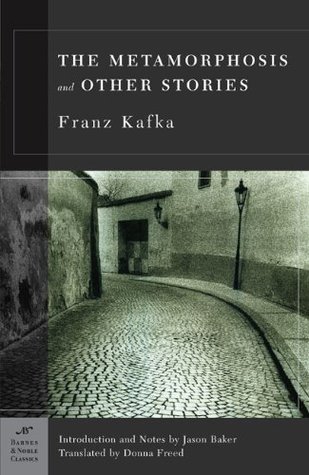
Reading Through the Classics: Franz Kafka's Short Stories
TITLE: The Metamorphosis and Other Stories
AUTHOR: Franz Kafka
CATEGORY: Classic
GENRE: Er....mixture?
STORIES IN VOLUME:
The Metamorphosis (1915)
The Judgement (1913)
The Stoker: A Fragment (1913)
In the Penal Colony (1919)
A Country Doctor (1919)
An Old Leaf (1919)
A Hunger Artist (1922)
Josephine the Singer, Or the Mouse People (1924)
Before the Law (1919)
MY THOUGHTS: So...Kafka. How to explain Kafka to those who haven't read it? Honestly...there's probably no real way to explain Kafka. He's one of those authors you just have to read for yourself.
Of these small stories, the best ones in my opinion are The Metamorphosis and In the Penal Colony. The rest...I don't really know what to make of them to be honest. Like...I don't think they're bad. But they're just...confusing. He's one of those kinds of writers that just puts you in a situation and expects you to make sense of things without giving any explanation. That's...something that kind of drives me batty to be honest. Like, I don't need everything spelled out for me...but at least have some explanation if you're going to turn a guy into a huge cockroach, just saying.
I honestly am not sure how I feel about Kafka. His stuff is interesting. It's just...so weird that I honestly don't know how I feel about it. I might be checking out some of his longer works in the future, I do know at least that much.
WHO SHOULD READ: Magical realism fans, literature fans
AUTHOR: Franz Kafka
CATEGORY: Classic
GENRE: Er....mixture?
STORIES IN VOLUME:
The Metamorphosis (1915)
The Judgement (1913)
The Stoker: A Fragment (1913)
In the Penal Colony (1919)
A Country Doctor (1919)
An Old Leaf (1919)
A Hunger Artist (1922)
Josephine the Singer, Or the Mouse People (1924)
Before the Law (1919)
MY THOUGHTS: So...Kafka. How to explain Kafka to those who haven't read it? Honestly...there's probably no real way to explain Kafka. He's one of those authors you just have to read for yourself.
Of these small stories, the best ones in my opinion are The Metamorphosis and In the Penal Colony. The rest...I don't really know what to make of them to be honest. Like...I don't think they're bad. But they're just...confusing. He's one of those kinds of writers that just puts you in a situation and expects you to make sense of things without giving any explanation. That's...something that kind of drives me batty to be honest. Like, I don't need everything spelled out for me...but at least have some explanation if you're going to turn a guy into a huge cockroach, just saying.
I honestly am not sure how I feel about Kafka. His stuff is interesting. It's just...so weird that I honestly don't know how I feel about it. I might be checking out some of his longer works in the future, I do know at least that much.
WHO SHOULD READ: Magical realism fans, literature fans
Sunday, October 2, 2016
Reading Through the Classics: The Sherlock Holmes Series

TITLE: The Sherlock Holmes series
AUTHOR: Sir Arthur Conan Doyle
PUBLICATION Started: 1887 Finished:1927
CATEGORY: Adult
GENRE: Mystery
PREMISE: A brilliant detective solves mysteries in England.
THOUGHTS: Over the past several months I've been going through the Sherlock Holmes series. It's been a process. Not because the books are hard. In fact, they're very easy books to understand. It's just they get repetitive. Now, I have read some Sherlock Holmes before this year. I read The Adventures of Sherlock Holmes a few years ago back when the Robert Downy Jr. movies started. I also did The Hound of Baskervilles back when the Sherlock TV show did their version of it.
To everyone moaning about how they became a procedural on CBS: please. That's actually the perfect format for these books. If you don't think so, that actually tells me you've maybe never actually read these books. Or if you have, you have a very rosy eyed view of them. Which can be a issue with a lot of Sherlock Holmes book readers. As poor Arthur Conan Doyle found out when he tried to quit writing the series.
If you only read one or two of the books, I recommend going for A Study in Scarlet and then either The Adventures of Sherlock Holmes or Hound of Baskervilles. The rest aren't very necessary, unless you want bragging rights about how you've read the whole series. Which, honestly, is mostly why I read the whole thing.
WHO SHOULD READ: Die-hard Sherlock Holmes fans, you want to say you've read the whole thing
ORDER OF SERIES: A Study in Scarlet
The Sign of Four
The Adventures of Sherlock Holmes
The Memoirs of Sherlock Holmes
The Hound of Baskervilles
The Return of Sherlock Holmes
The Valley of Fear
His Last Bow
The Casebook of Sherlock Holmes
Note: sorry about weird formatting, blogger was being a pain today for some reason.
Labels:
classics,
mystery,
published in the 1800s,
published in the 20s,
series
Tuesday, May 10, 2016
Reading Through the Classics: A Room of One's Own
TITLE: A Room of One's Own
AUTHOR: Virginia Woolf
CATEGORY: Non-Fiction
GENRE: Essays
PUBLISHED: 1928
PREMISE: Essays written by Virginia Woolf based on a series of lectures she gave about female writers and fiction.
MY THOUGHTS: One of the many holes in my education was that we had never read Virginia Woolf. I thought I'd finally rectify that this year with one of her short ones: A Room of One's Own. Mostly because it was short and it was an essay. I've been getting into essays lately and I figured it would be a good introduction to her writing style.
While I don't know if this is like her other books yet, I do know this was definitely an interesting read. Some of the thoughts in it are a tad dated, because it was written back in the twenties. But I can't help but draw parallels between this and the current on-going discussion among the book/fandom community at large about the need for more diversity. All Woolf is basically saying in this is that female writers should be given the same opportunities as male writers. That's literally all the discussion about representation and plea for more diversity is. It's sad to me that it's been over eighty years since this essay and we're STILL having these conversations.
I will say a lot of this wanders. Woolf does some metaphorical things that...I don't particularly get, I'll be honest. I don't know if that's me or her writing. But this does what essays should do: gets her point across and makes you think. She takes a bit to get the point. But she does get there. And it is sadly still a very relavant point.
WHO SHOULD READ: Virginia Woolf fans, essay fans, feminists
AUTHOR: Virginia Woolf
CATEGORY: Non-Fiction
GENRE: Essays
PUBLISHED: 1928
PREMISE: Essays written by Virginia Woolf based on a series of lectures she gave about female writers and fiction.
MY THOUGHTS: One of the many holes in my education was that we had never read Virginia Woolf. I thought I'd finally rectify that this year with one of her short ones: A Room of One's Own. Mostly because it was short and it was an essay. I've been getting into essays lately and I figured it would be a good introduction to her writing style.
While I don't know if this is like her other books yet, I do know this was definitely an interesting read. Some of the thoughts in it are a tad dated, because it was written back in the twenties. But I can't help but draw parallels between this and the current on-going discussion among the book/fandom community at large about the need for more diversity. All Woolf is basically saying in this is that female writers should be given the same opportunities as male writers. That's literally all the discussion about representation and plea for more diversity is. It's sad to me that it's been over eighty years since this essay and we're STILL having these conversations.
I will say a lot of this wanders. Woolf does some metaphorical things that...I don't particularly get, I'll be honest. I don't know if that's me or her writing. But this does what essays should do: gets her point across and makes you think. She takes a bit to get the point. But she does get there. And it is sadly still a very relavant point.
WHO SHOULD READ: Virginia Woolf fans, essay fans, feminists
Subscribe to:
Posts (Atom)